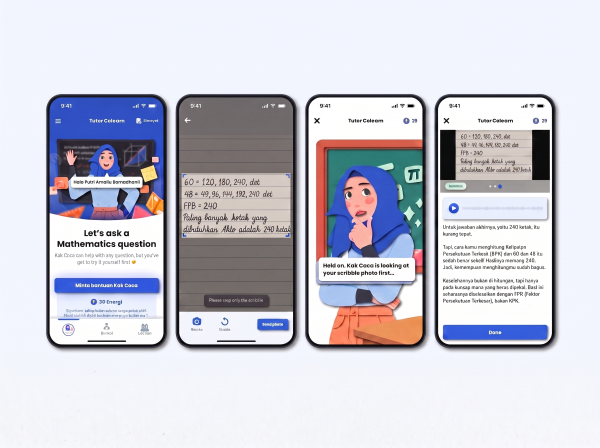
As generative AI chatbots become increasingly prevalent, their optimization for rapid information retrieval and task efficiency presents a unique challenge in educational settings. When students utilize these tools for immediate answers, they often bypass the “productive struggle”—the critical cognitive process required for genuine learning and schema construction.
Introducing 'Kak Caca', CoLearn first AI Tutor
, To address this, CoLearn has partnered with Google DeepMind to launch Kak Caca, our first AI Tutor powered by the Gemini 2.5 Flash model. When designing this tool, we grounded our development in a fundamental pedagogical question: What would an effective human tutor do?
A skilled educator does not simply hand over the solution. Instead, they ask the student to demonstrate their current understanding, identify underlying misconceptions, and pinpoint knowledge gaps. Kak Caca was engineered to replicate this exact instructional methodology.
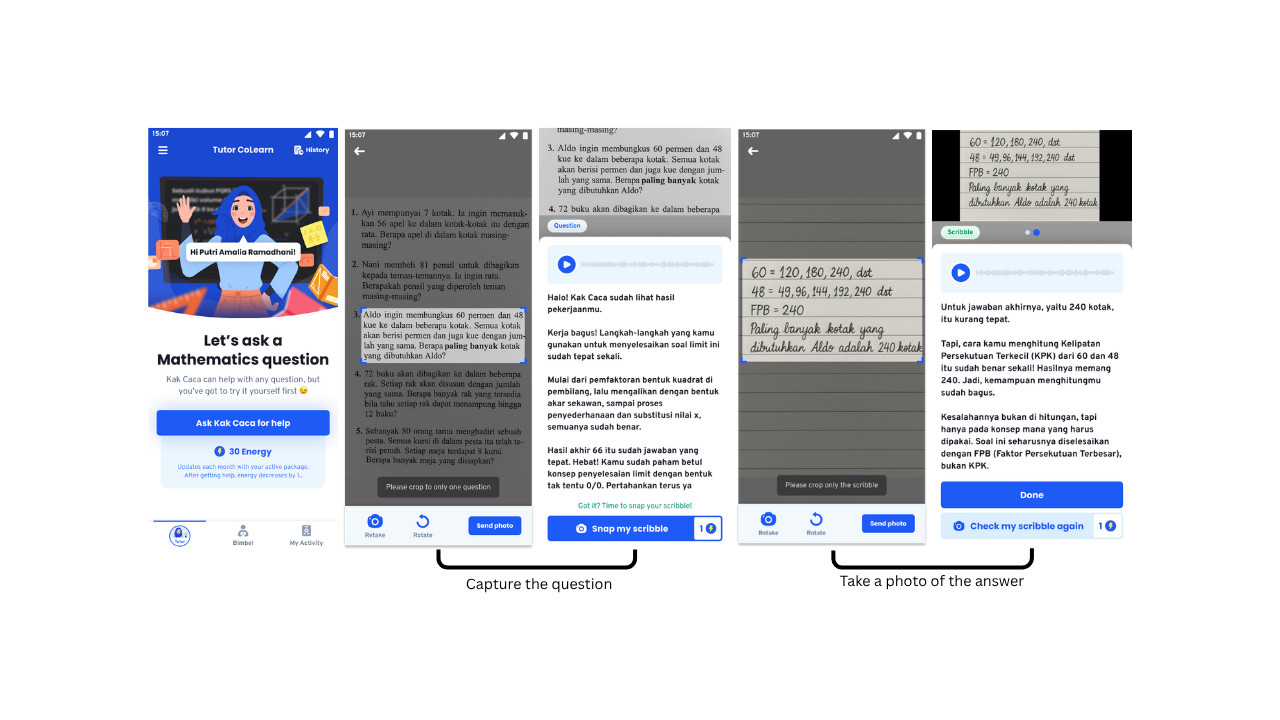
Kak Caca is built upon an “anti-shortcut” design philosophy, governed by a simple but strict principle: without student effort, there is no algorithmic assistance. Rather than functioning as an instant answer engine, the platform mandates a structured level of student engagement through a four-step scaffolding process:
Capture the question: The student takes a photograph of their specific mathematics or science problem.
Submit the initial attempt (“scribbles”): Before any AI guidance is generated, students must attempt the problem and capture a photo of their written work or “scribbles.”
Multimodal analysis: Leveraging Gemini’s advanced multimodal capabilities, the system cross-references the original question with the student’s submitted attempt to diagnose the specific nature of their confusion.
Audio-guided scaffolding: Targeted hints and instructional scaffolding are delivered via audio in native Indonesian. This allows students to maintain visual focus on their own written work while absorbing the explanations of their errors.
To ensure the technology serves as a true educational partner rather than a shortcut, we implemented specific technical and design constraints:
Diagnostic multimodal evaluation: The AI does not independently solve the textbook problem; it actively analyzes the student’s handwritten methodology to spot specific procedural or conceptual errors, delivering highly targeted feedback.
Curriculum-strict “No Chatting” policy: To prevent cognitive distraction and maintain academic rigor, the interface bars students from initiating general conversations with the AI. All interactions are strictly confined to problem analysis and curriculum-relevant scaffolding.
A Specialized Approach to EdTech
It is necessary to distinguish Kak Caca from general-purpose generative AI. While broad consumer AI models are optimized to act as productivity assistants that reduce friction, Kak Caca is intentionally designed with pedagogical friction in mind. By requiring an active initial attempt and restricting non-academic dialogue, the system acts as a specialized learning scaffold aimed at sharpening critical thinking and long-term knowledge retention.
Future directions
In the coming months, we will be integrating Kak Caca directly into the practice modules of our cohort-based live classes. Additionally, development is underway for an international release, expanding this effort-driven AI framework to a global audience.