Raising the cognitive bar: How AI can drive equitable education in Southeast Asia
Across Southeast Asia, education systems are at a critical juncture. As artificial intelligence enters the classroom, a pressing question emerges for educators, policymakers, and investors alike: Will AI democratize quality education, or will it inadvertently widen the learning divide?
A recent brief by EdTech Hub, titled AI in Southeast Asia: Marginalised Learners, investigates this landscape. The report highlights how strategic implementations of AI can expand access for underserved communities. We are deeply honoured to be featured as a leading case study demonstrating how AI can be thoughtfully engineered to scaffold learning rather than bypass it. In a region as diverse as Southeast Asia, building technology that is genuinely accessible to the wider population isn’t just important—it is essential to bridging the educational divide.
Here is a look at the insights from the report and how CoLearn’s pedagogical approach to AI is shaping the future of inclusive education.
The pitfall of cognitive offloading
The most common application of generative AI in education today is the instant-answer model. A student scans a complex math or physics problem, and an AI instantly generates the final solution.
While efficient, this approach introduces a significant risk: cognitive offloading. When technology does the heavy lifting, students are deprived of the essential friction required to build mental models. Long-term knowledge retention relies heavily on retrieval practice and active schema construction. If an AI tool merely hands over the answer, the student experiences zero productive struggle, resulting in superficial engagement rather than genuine academic growth.
Our approach: engineering productive struggle
Focused heavily on foundational STEM education, we have built an AI-enabled ecosystem designed to raise the cognitive demand on students rather than lower it.
1. "No effort = No answers"
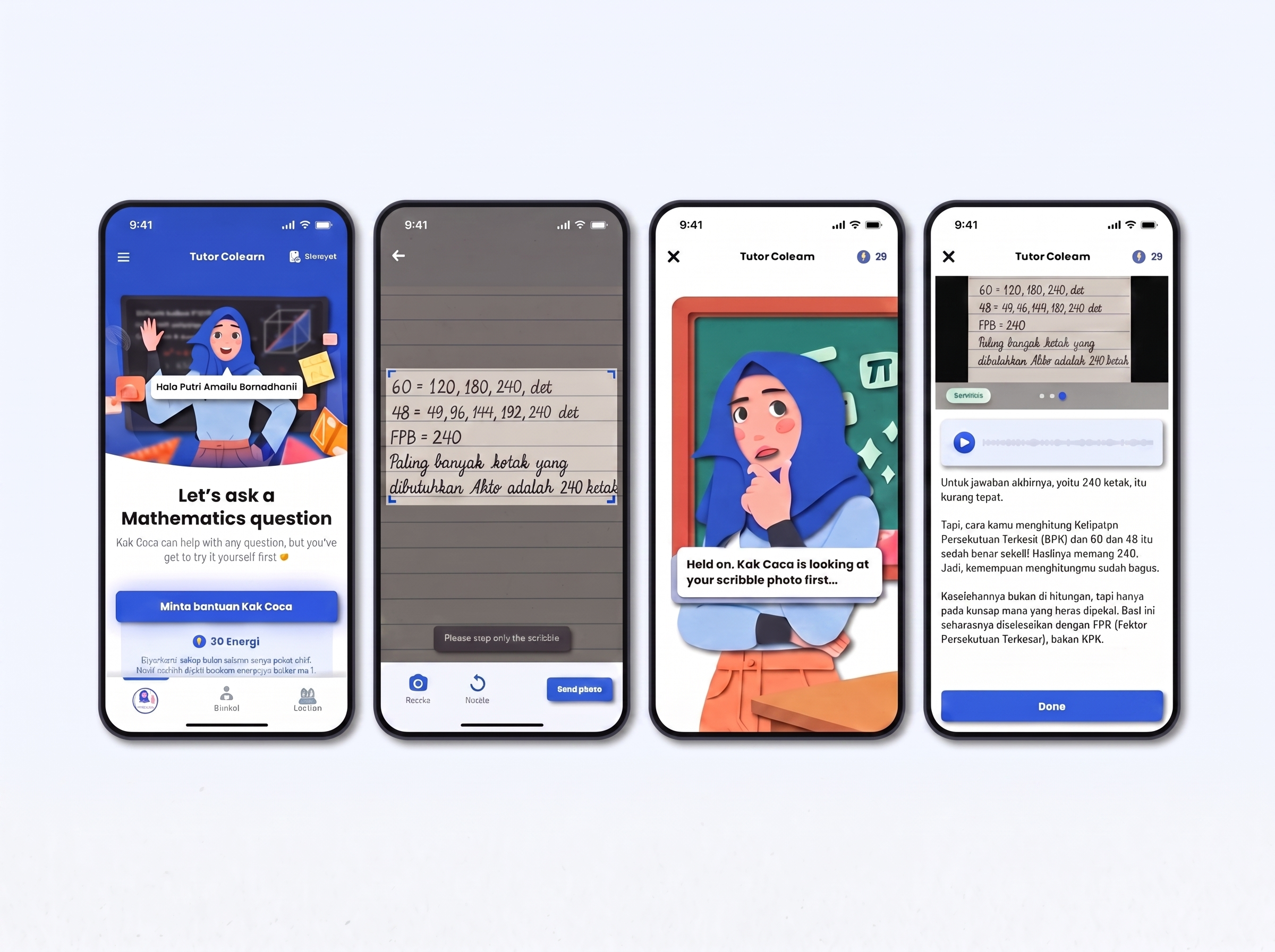
The app is designed to ensure students actually think. Before receiving any help, a student must attempt the math or science problem by writing down what they already know. If they get stuck, the AI doesn’t give them the final answer. Instead, it analyzes their specific work, identifies where the mistake happened, and provides a customized hint or example so the student can continue solving the problem on their own.
2. Audio guidance for focused learning
Many AI tools glue students to a screen. CoLearn’s AI utilizes personalized audio guidance, allowing students to keep their eyes on their physical notebooks. This multi-sensory approach mimics having a real tutor sitting next to them, walking them through the problem step-by-step while they write.
3. Scaling Quality for Low-Resource Contexts
For marginalized learners, the barrier to quality tutoring is usually cost or geography. By combining this AI-driven homework assistant with affordable, cohort-based online tutoring, CoLearn makes high-quality academic support accessible at scale. Students who previously could not afford private tutors now have access to expert educators and an intelligent AI assistant that guides their independent study time.
You can read the full insights and explore other case studies by downloading the complete EdTech Hub report: AI in Southeast Asia: Marginalised Learners.